


Last Update: May 8, 2024
Dear SDV Community,
Welcome to the Synthetic Data Vault! Here, you will find a group of passionate creators and builders who want to put synthetic data to use.
Our goal with the SDV is to be the most comprehensive and trusted platform for synthetic data. Since we started the SDV Slack Community in July 2020, we've seen unprecedented innovation and collaboration in this space. As we continue to improve the software and discover new insights about synthetic data, we want to make sure our community is set up for responsible growth.
To that end, we are introducing some SDV Slack Community Guidelines, aimed to foster more of the great engagement we've been seeing. Below, you'll find 5 key principles that we expect all Slack Community members to follow.
- Discuss and participate openly
- We encourage SDV Slack members to create profiles that accurately represent who they are, including their name, profile image and email. Please do not deliberately change your identity in order to mislead the community, for example by providing a temporary email or a fake name or profile photo. Impersonating others could also result in your expulsion.
- We encourage everyone to communicate in public channels instead of through private Direct Messages (DMs). When you keep discussions in the public space, everyone in the community can benefit from the solutions that you find, and others can also join in. This also applies to communicating with SDV team members — we try to respond to questions on a first-come, first-serve basis, and generally get to everything within a few business days. You will not receive a faster response by directly messaging individual members of the SDV team.
- Keep the workspace organized
- Continue with involved discussions on GitHub
- Debugging problems is easier on GitHub if there are many code samples or stack traces being shared. If the bug cannot easily be reproduced or fixed, we'll track its updates using GitHub too.
- We also use GitHub to keep track of new feature requests. We prioritize new features based on the demand and the utility for synthetic data use cases. If you'd like to call attention to a particular feature request, we encourage you to add more information about how you're planning to use the synthetic data, and why the feature would be helpful.
- Keep the focus on SDV usage
- While we recognize that there are a lot of discussions, news and articles about synthetic data and generative AI in general happening right now, please refrain from posting them to any of the SDV channels (including the "random" channel). These include any general industry news about synthetic data; third party vendor evaluations, or successful case studies. This rule applies to the SDV itself: we will not post (or allow others to post) coverage of the SDV in business news, articles about industry usage of the SDV, successful case studies of the SDV, or evaluations by other vendors or third parties. We believe this content is more suitable for LinkedIn and other venues.
- Please refrain from advertising or soliciting anywhere in the SDV Slack, as this creates a bad experience for the community. Promotion of a specific business or research project may result in your expulsion from the Slack space. If you are receiving solicitations or spam from someone, please get in touch with the SDV team at info@sdv.dev for a resolution.
- Be respectful
We created our Slack Community as an open place to discuss the SDV. Anyone can join our community by creating a profile. Whether it's through asking questions, having detailed discussions or reacting to existing conversations, you are welcome to engage with the community in any way you feel comfortable. Feel free to answer questions by replying in a thread, especially if you've run into the same problems in the past or have workarounds.
The guidance below allows us to keep the community safe:
Before starting a discussion, check to see if there is already material that covers the topic. We have many resources including: GitHub Issues, SDV User Guides and the DataCebo Blog.
If you cannot find any related material, post your question in the appropriate channel depending on the use – for eg. #single-table, #multi-table, #timeseries, #sdmetrics, etc. For general questions, use #sdv-dev. We recommend you use only 1 block of text to write your initial question. The text will become the start of a new thread, and new replies will appear nested underneath it:
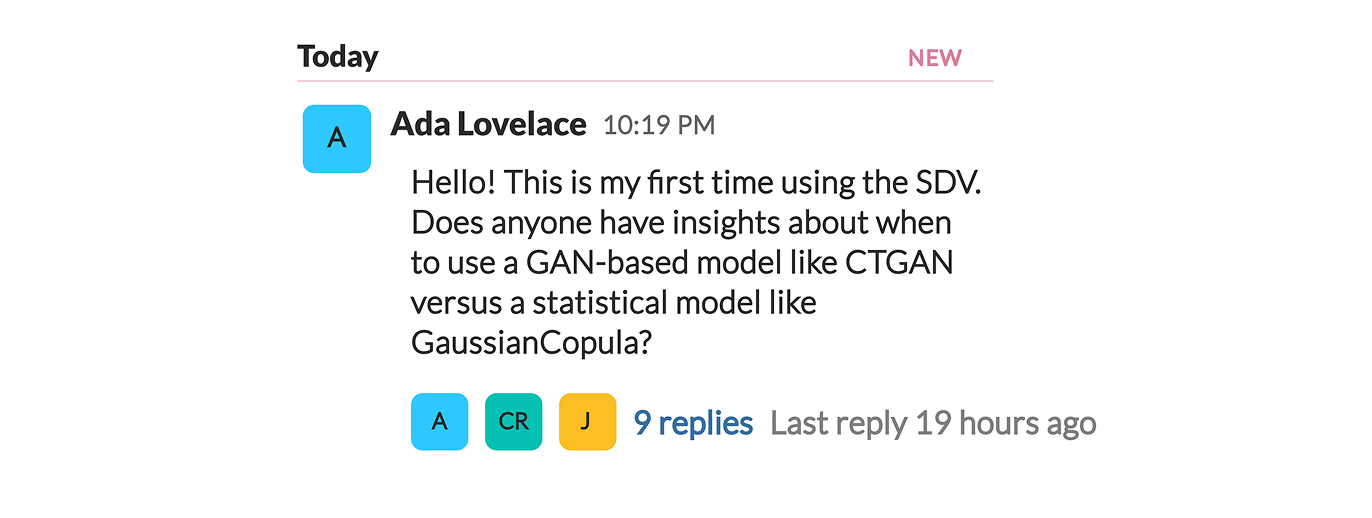
(We recognize that there may be bots or Apps that you use in other Slack spaces. Currently, we are not accepting any requests to add external Slack Apps to the SDV space.)
While Slack is a great place for initial connection and conversation, we are using GitHub for more involved topics, which require a more permanent location for tracking and updating. In certain scenarios, a member of the SDV team may ask you to continue a Slack discussion on GitHub instead:
The primary focus of the SDV Slack is to discuss the SDV software. Due to recent growth in users and usage questions, and our goal of supporting users in every way possible, we are adopting a new policy: Slack members must stick to posting SDV usage questions and discussions only. Here's what this means:
We are thrilled to have a global community that represents many different industries, backgrounds and experiences. It is important for everyone to keep this diversity in mind while communicating. A question that might seem obvious to you may not be to someone else, and you may receive faster replies if you explain any industry-specific terms. While others may not share your understanding of physics, chemistry, finance, healthcare, etc., we all share a love for data!
We ask that you also extend this respect to the SDV team. As the core maintainers of this project, we are a passionate but small team responding to a variety of requests and questions. Please be mindful of this as you communicate with and wait for responses from us.
Thank you for taking the time to read our community guidelines. With these in mind, we hope the SDV Slack will continue to grow as an open space for discussion and collaboration around synthetic data solutions.
Happy synthesizing!
The SDV Team
