Critical capabilities for AI-generated synthetic test data
AI coding assistants have made the shift-left testing urgent. Synthetic data can help, but only if it captures far more than statistical realism.
Read the storyResearch, engineering perspectives, product thinking, and practical applications from the team building the Synthetic Data Vault.
AI coding assistants have made the shift-left testing urgent. Synthetic data can help, but only if it captures far more than statistical realism.
Read the storySDV 2.0 turns any enterprise database into a Generative Relational Model, a reusable AI asset trained on your own proprietary data.
Should enterprises access AI through an API which involves sending those labs their proprietary data? Or should they access AI by installing open source models on-premises and further training them on enterprise-specific data?
Enterprise relational data is becoming a new
medium for generative AI.We cover the ideas, and systems shaping what comes next.
Explore seven critical capabilities that go beyond statistical realism, from business rules to edge cases.
Explore more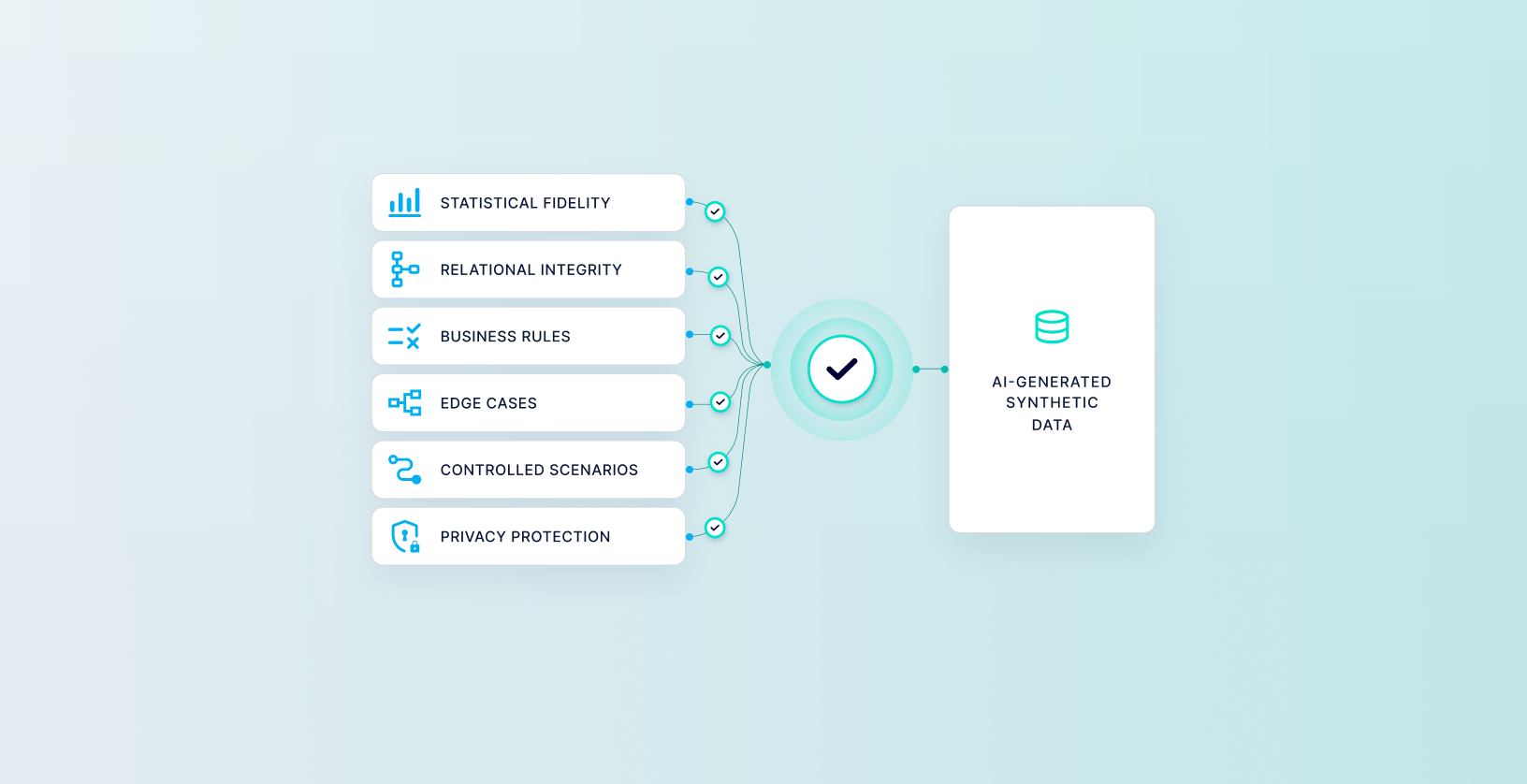
Using a model from the Synthetic Data Vault (SDV), a UCLA team has shown that credit card fraud-detection can be dramatically improved by generating synthetic case data consistent with past examples of fraud. They show that they can reduce the false negatives by a factor of 20x.
Read moreSynthesizers can create diverse data that is also high quality. Check out how these two vital traits inform each other and drive great business outcomes.
Read moreWhat happens when you train a machine learning model on synthetic data instead of real data? Let's experiment to find out.
Read moreCurated series · 3 parts
Go from the foundations of synthesizer disclosure to empirical verification and enterprise deployment.
Explore the seriesPart 1
Synthesizers are game-changers for data disclosure and differential privacy. Use them to create unlimited, differentially private synthetic data.
Part 2
You can trust that your software is applying differential privacy, but can you verify it for yourself? Use our framework to measure privacy for any synthesizer.
Part 3
Are you evaluating synthetic data vendors? Look out for these signs that their software might be violating privacy.
GPS data is often PII but anonymizing GPS data while preserving useful context is difficult. Learn about the challenges and how we solved them in this post.
To create multi-table synthetic data, it's important to learn the connections between tables. Explore 3 different approaches to the challenge.
Can you anonymize PII without sacrificing usability? Explore the latest techniques in anonymization.
AI Connectors allow users to create robust, referentially sound synthetic data by connecting to an existing database and automatically creating highly accurate metadata, regardless of the underlying database technology.
Explore the methods behind measuring statistical fidelity, downstream utility, and privacy.
Explore more

AI coding assistants have made the shift-left testing urgent. Synthetic data can help, but only if it captures far more than statistical realism.

SDV 2.0 turns any enterprise database into a Generative Relational Model, a reusable AI asset trained on your own proprietary data.

Should enterprises access AI through an API which involves sending those labs their proprietary data? Or should they access AI by installing open source models on-premises and further training them on enterprise-specific data?

Trained AI models do what LLMs cannot: Generate survey responses with the statistical variety and demographic accuracy your analysis depends on.

Synthetic data does what ETL pipelines cannot: Create unlimited test data with low infrastructure, storage, and system complexity.

What happens when you train a machine learning model on synthetic data instead of real data? Let's experiment to find out.

Many vendors compare against SDV Community to signal enterprise readiness—but those comparisons often hide critical gaps. In real enterprise environments, these shortcuts break down. Here’s how to evaluate solutions the right way.

See how DataCebo enables enterprises to create generative AI models without needing to access their data. With fast debugging, seamless integration, and robust testing, it makes scalable adoption possible.

Make synthetic data a reality
Solutions
Product
Company
Customers
Resources