Synthetic Data Vault
for Enterprise

Build a generative relational model of your complex database. Use it to create synthetic databases inside your secure environment.

Create synthetic databases for
Any scale
hundreds of related tables
Any schema
Complex databases
Your environment
Your data remains secure
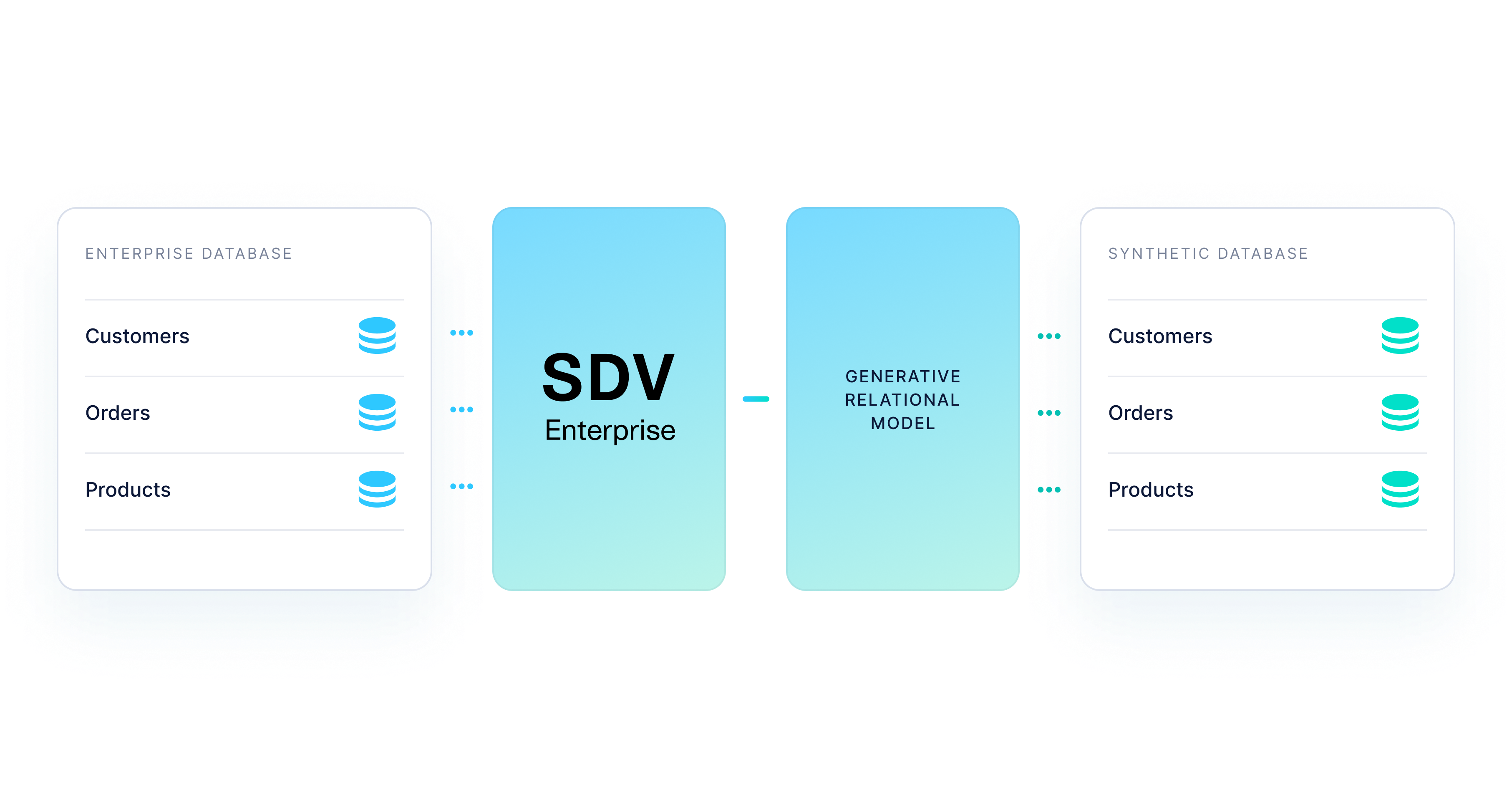
An enterprise database of Customers, Orders and Products feeds the SDV Enterprise generative relational model, which produces a synthetic database with the same tables.

Build one generative relational model.
Generate the data every team needs.

Software & agentic testing

Test more scenarios before production

Generate application-valid databases for software, AI agents, and end-to-end workflows—including rare states and realistic errors.

Explore application

AI models & agents

Improve performance when examples are scarce

Create balanced data for training and evaluating predictive models, copilots, agents, and rare outcomes.

Explore application

Scenario simulation

Explore decisions before changing production systems

Generate controlled populations, events, and what-if conditions while retaining realistic dependencies across tables.

Explore application

Data sharing

Expand access without distributing sensitive records

Provide useful synthetic datasets or privacy-preserving models while real data remains inside your environment.

Explore application

The Synthetic Data Vault:
one system from connection to consumption.

Build your own foundation model and an enterprise synthetic-data capability without assembling a collection of disconnected tools and pipelines.

1

Bring your data

Connect databases or load files. Automatically detect metadata, data types, keys and relationships.

2

Configure the training

Add business rules, privacy requirements, target conditions, and advanced models or let SDV Enterprise automatically configure it for you.

3

Train your model

Capture distributions and relationships across complex, multi-table enterprise schemas.

4

Deploy your model

Sample any volume on demand and export it into downstream systems and applications.

LLMs learn the world’s language.
Generative relational models learn your enterprise.

Generative relational models learn the structure, relationships, distributions, and business rules embedded in your enterprise databases. They use that learned representation to generate new, referentially valid relational data.

A language model learns broad language intelligence from public and licensed text, and generates new text.

Language model

Broad language intelligence

Shared foundation model

Public and licensed text

A generative relational model learns enterprise data intelligence from your enterprise database, and generates new relational data.

Generative relational model

Enterprise data intelligence

Enterprise-owned model

Enterprise database

What language models are built for, learn, are trained on, and generate
CapabilityLanguage models
Built forLanguage and unstructured content
LearnPatterns and meaning in language
Trained onBroad collections of public and licensed text
GenerateContextually plausible text
What generative relational models are built for, learn, are trained on, and generate
CapabilityGenerative relational model
Built forStructured, multi-table enterprise data
LearnStructure, relationships, distributions, and business rules
Trained onYour proprietary data, inside your environment
GenerateNew, referentially valid relational data

SDV Enterprise gives organizations the infrastructure to build, customize, and deploy generative relational models on their own data.

Start modeling your relational data
with SDV Enterprise

Build your workflows with generative relational models.

Statistical similarity is not enough.
Behavioral fidelity is what matters.

A bundle does not learn a model. Use build or train generative relational models.

Relational structure

  • Schema fidelity
  • Referential integrity
  • Cardinalities

Business logic

  • Business constraints
  • State transitions
  • Application logic
  • Realistic user behavior

Edge cases

  • Rare events
  • Anomalies
  • Realistic errors

Behavioral dependencies

  • Causal relationships
  • Temporal behavior

SDV Bundle

From enterprise database to generative relational model — automatically.

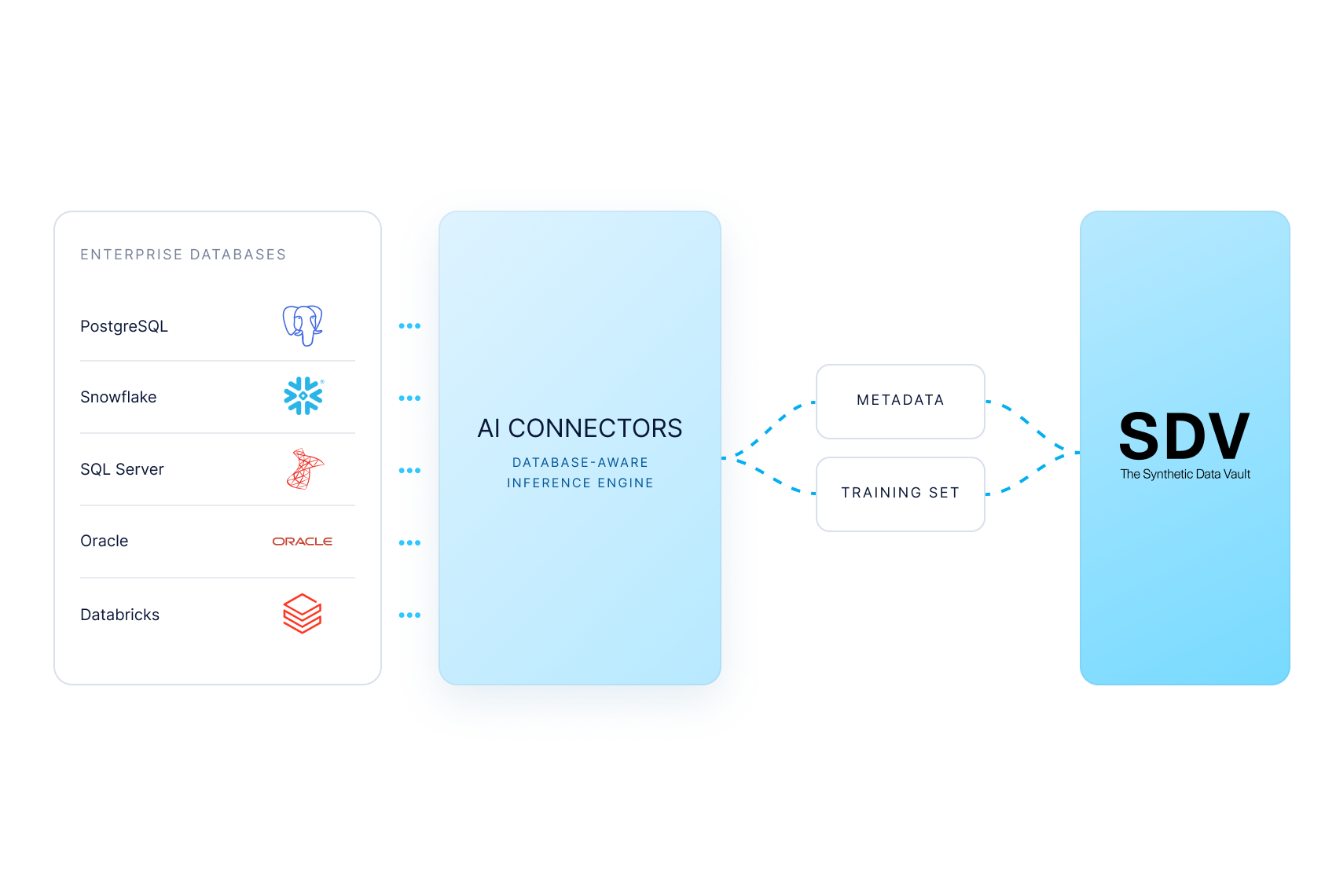
Connect your database to AI Connectors to create accurate metadata, extract a referentially sound multi-table training set for SDV. Export synthetic data back into a database, all without custom pipelines.
  • Database-aware metadata inference
  • Incremental, referentially sound subsampling
  • Integrated import and export
Explore AI Connectors
Enterprise databases feed the AI Connectors database-aware inference engine, which reads schema, keys and relationships to produce accurate metadata, a referential training set, and an export-ready synthetic database.

SDV Bundle

Teach the model the rules critical to your business

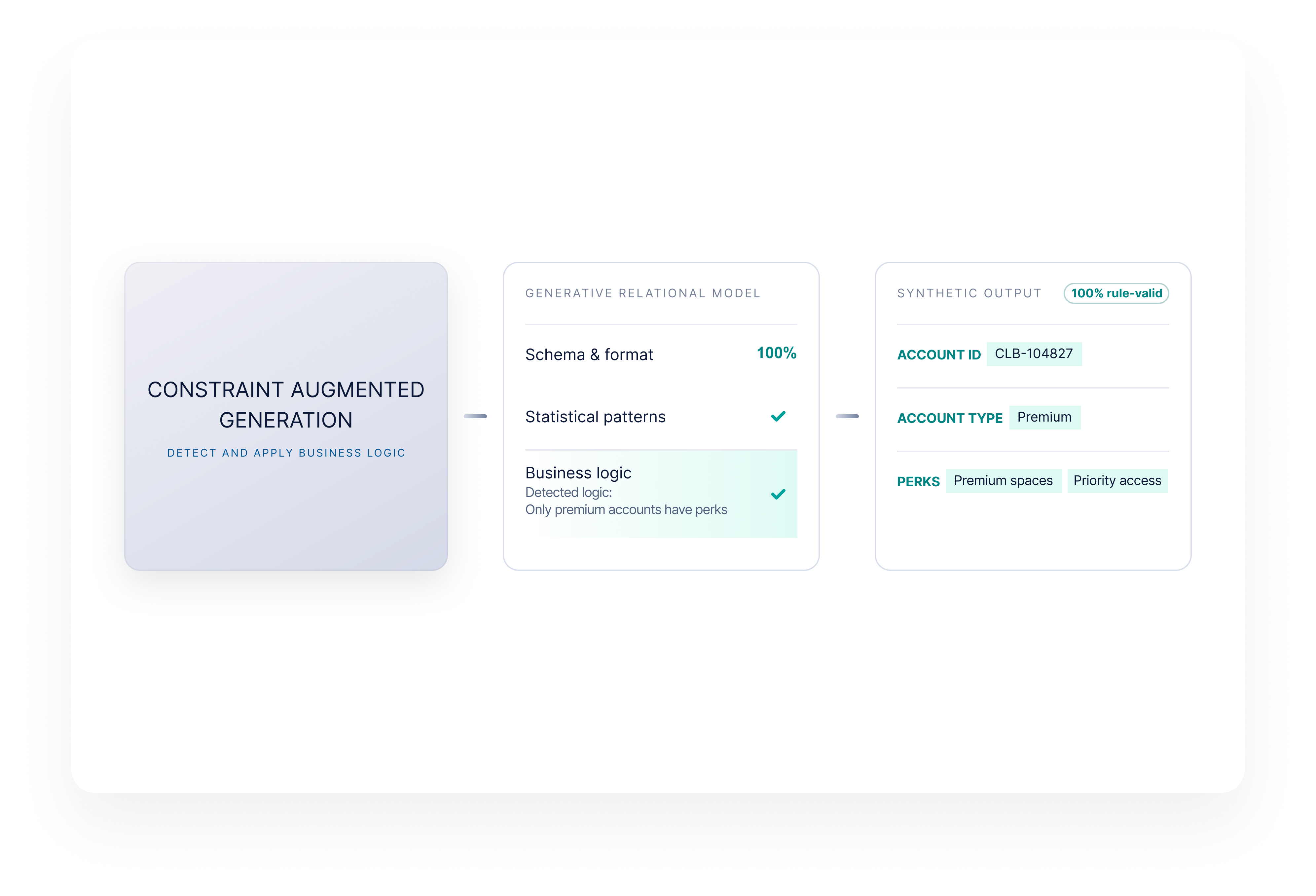
Generative AI learns schemas and statistical patterns. Constraint Augmented Generation learns business logic your applications depend on and trains the generative relational model to follow those rules. The generated synthetic data is 100% valid.

Constraint Augmented Generation
  • Automatically detects business logic constraints in your data
  • Adds the corresponding predefined CAG patterns
  • Injects its specialized engine into an SDV synthesizer
  • Eliminates separate pre- and post-processing logic
Explore CAG patterns
Constraint Augmented Generation detects and applies business logic, so the generative relational model matches schema and format, statistical patterns, and the detected rule that only premium accounts have perks; the synthetic output is 100% rule-valid.

SDV Bundle

Build differentially private models. Share your models with confidence.

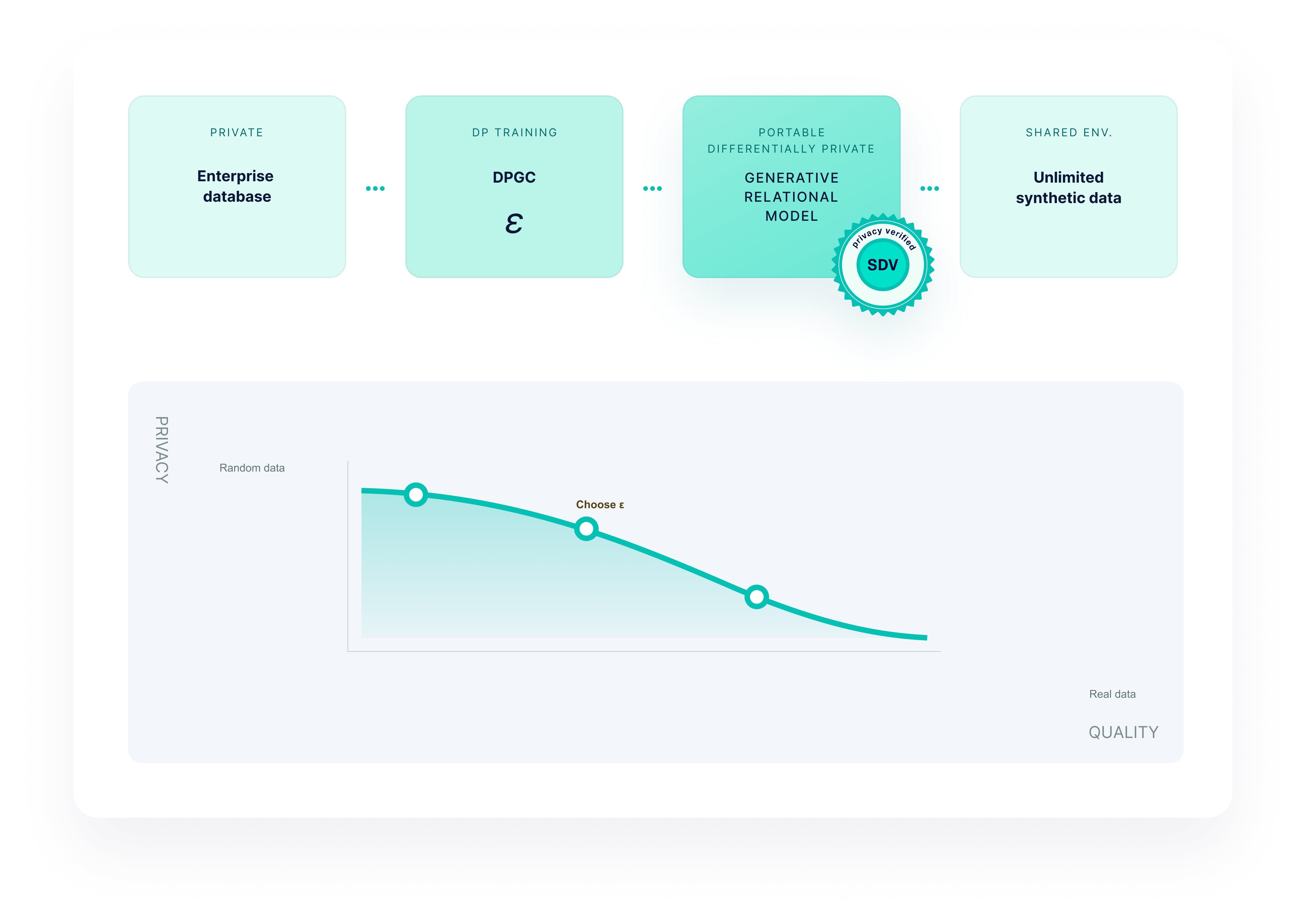
Train a differentially private generative relational model, empirically assess its privacy-preserving capabilities with SDV Verified, and share one portable model instead of moving sensitive data between teams and environments.
  • Analyze privacy–quality trade-offs with PQ curves
  • Generate unlimited or conditional synthetic data downstream
  • Enable vendor testing, secure experimentation, and federated AI
Explore Differential Privacy
A private enterprise database trains a DPGC synthesizer at a chosen epsilon, producing an SDV Verified portable differentially private generative relational model that generates unlimited synthetic data in a shared environment, alongside a privacy-quality curve for choosing epsilon.

SDV Bundle

Generate the targeted data for the scenarios you need

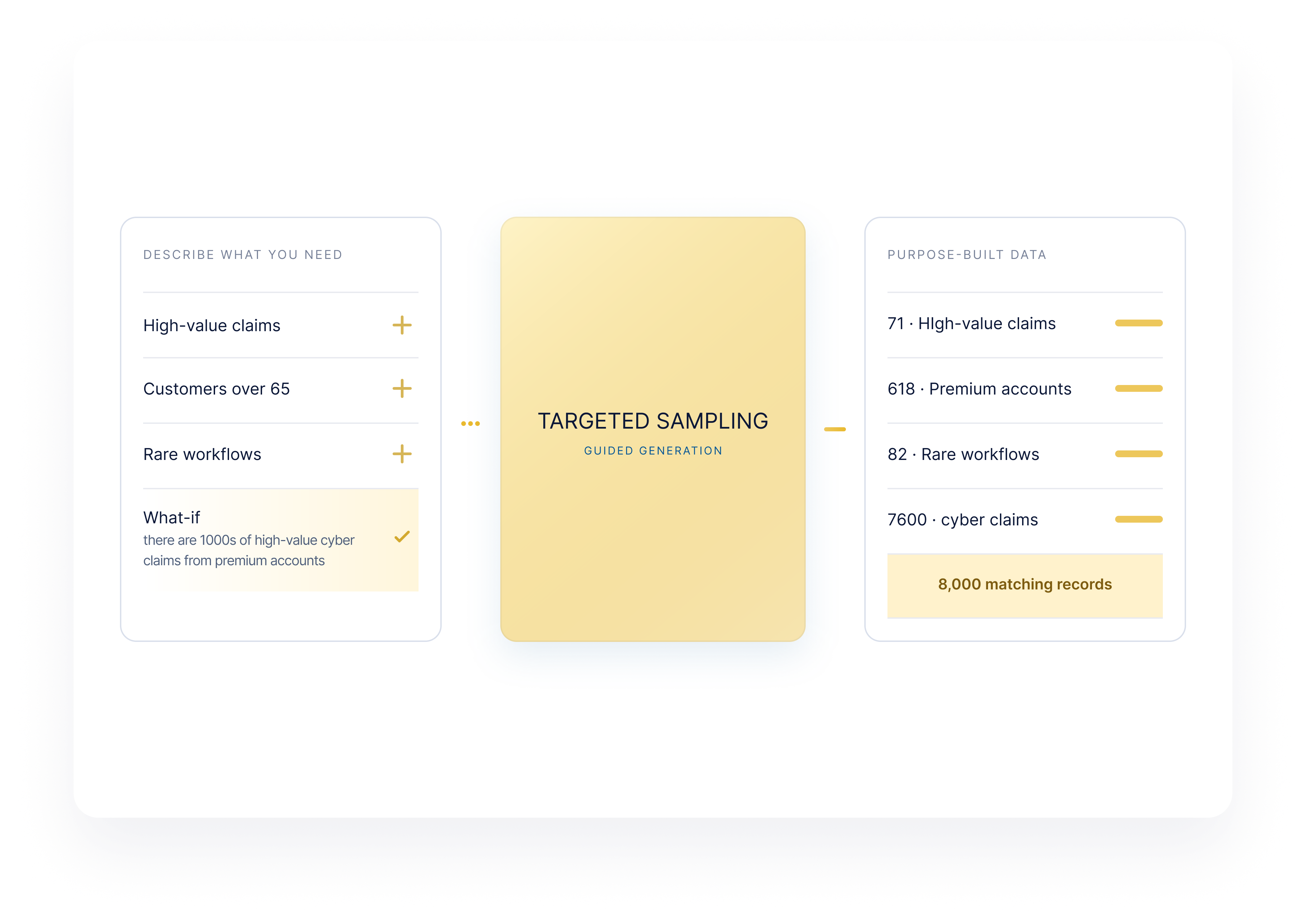
Describe a population or condition and guide the generative relational model toward it. Create new, realistic records for rare workflows, high-value segments, edge cases, and what-if scenarios at the volume your downstream task requires.
  • Generate underrepresented populations at useful volume
  • Avoid generating and filtering large random samples
  • Build purpose-specific datasets for testing, analytics, and AI
Explore Targeted Sampling
Describe what you need—high-value claims, customers over 65, rare workflows, or a what-if condition—and guided targeted sampling turns it into purpose-built data broken down by segment, totalling 8,000 matching records.

Deployed where your data already lives.

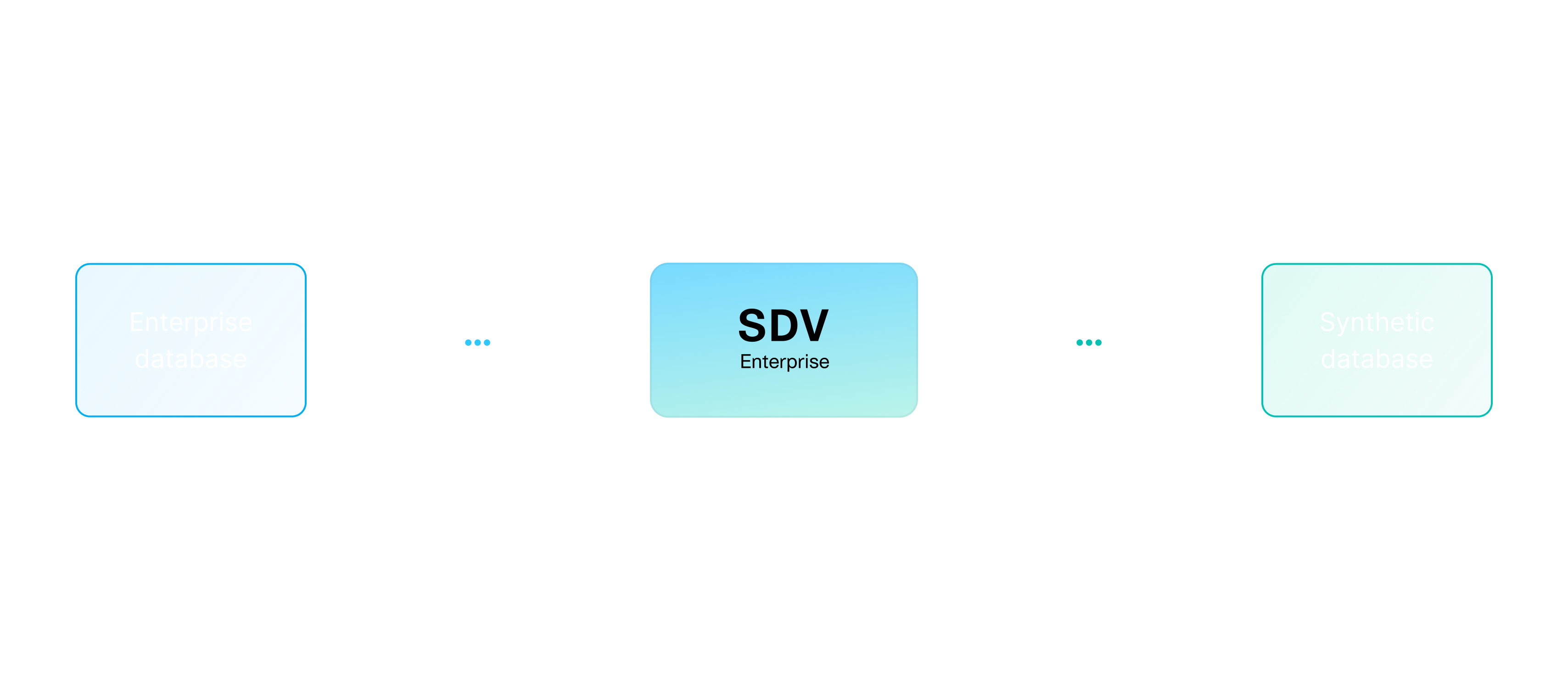
SDV Enterprise is a downloadable Python SDK. Your team installs it in your secure environment and calls it from your own software.
Python native
Integrate into existing data and engineering workflows.
Low compute
Train and sample without dedicated GPUs.
Full control
Keep models, inputs, and outputs in your security boundary.
Discuss your deployment
Inside your secure environment, your enterprise database flows into the SDV Enterprise Python SDK, which produces synthetic data. No customer data leaves your environment.
“SDV Enterprise is designed for enterprise-scale databases and includes the necessary automation features…SDV is a software development kit; this gives us a lot of flexibility in its use and in our ability to integrate it into our ING landscape.”

Wim Blommaert

Head of Test Data Management, ING Belgium

Datacebo logo

Make synthetic data a reality

© 2026 DataCebo, Inc.