SDV Enterprise for software testing
Generate better test data with AI.For every stage of software testing.
Test more scenarios, catch critical bugs earlier, and release faster with realistic synthetic test data that preserves your database relationships and business rules. Generate the scenarios and volumes each test needs with SDV Enterprise, entirely inside your environment.
“You can force the AI to generate data specifically by following your instructions to test special cases which can be more effective than copying millions of data from production and hoping that whatever you needed was in there.”

Wim Blommaert · Head of Test Data Management, ING Belgium

ING Belgium achieved 100× payment test coverage
Using SDV Enterprise, ING Belgium generated 10,000 synthetic SEPA payments in under two minutes and reported an estimated 100× improvement in payment test coverage.
See how ING achieved 100× test coverageManual test data creation
AI-generated synthetic test data with SDV Enterprise
Around 10 valid SEPA payments
Created manually as XML messages
10,000 synthetic SEPA payments
Generated using SDV Enterprise
At least 1 hour
To manually create around 10 valid payments
Under 2 minutes
To generate 10,000 synthetic payments
Limited test coverage
Small manually created datasets restricted scenario coverage
100× test coverage
Conservative estimate, achieved in one-tenth the time
One model instead of multiple
test data workflows
SDV Enterprise replaces fragmented test data workflows with a reusable generative relational model that can produce the data each test requires.
Most traditional workflows
GRM workflow (using a single trained generative relational model)
Copy and mask production data
Copy records into test environments and maintain masking pipelines.
Generate entirely new test data
Use the trained model to generate synthetic records without copying production records into test environments.
Create and maintain data subsets
Reduce volume while trying to preserve relationships and important scenarios.
Generate the required volume
Use the same model to generate smaller development datasets or production-scale performance datasets.
Configure rules and basic generators
Manually define how individual fields and records should be generated.
Generate application-valid databases
Use the same model to preserve learned patterns, relationships, and business rules across tables.
Prepare and share static datasets
Maintain fixed datasets, which can become stale or lack conditions required for testing.
Generate reproducible scenarios on demand
Use the same model to recreate real failures or to generate the conditions required for a specific test.
Generate synthetic test data with or without production data.
Easily accessible test data
Using schema and metadata
Start testing without production records
Generate structurally valid data from table definitions, field types, relationships, and constraints without providing production records.
Realistic test data
Using aggregate data profiles
Add realism without sharing records
Add statistical realism using distributions, ranges, frequencies, and other aggregate information without sharing row-level production data.
Highest quality test data
Using production data
Capture the complexity your tests need
Build a generative relational model that learns statistical patterns, table relationships, and business rules to generate realistic, application-valid test data.
Recommended for complex application testing
How SDV Enterprise works
Build a generative relational model for each application or database.
Start with your production database and use it to build a generative relational model without moving production records into lower environments.
- Your data stays in your environment
- Model your existing relational structure
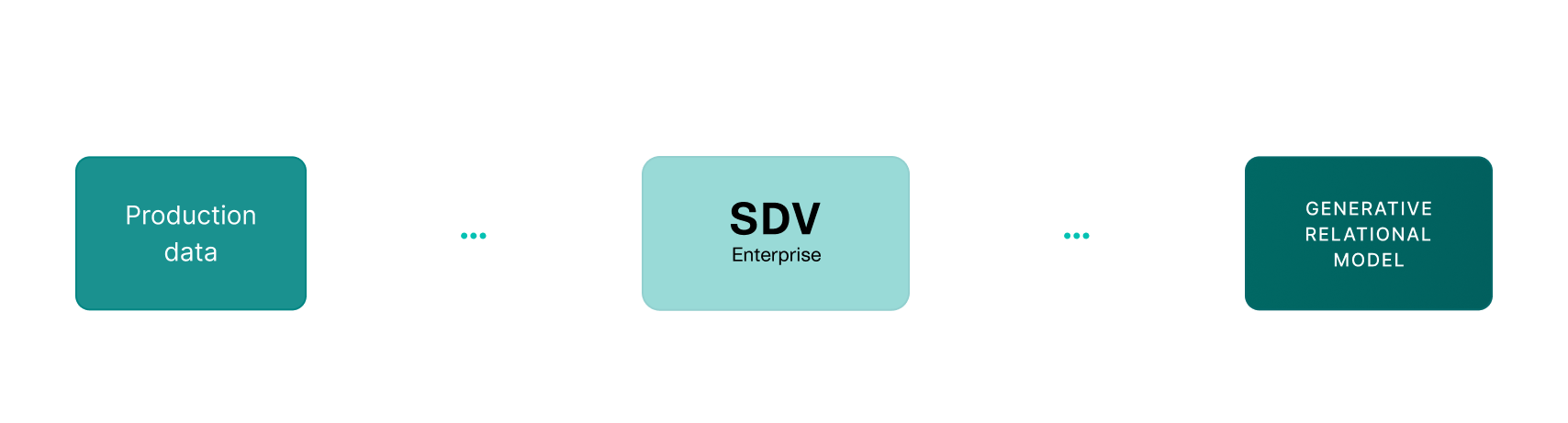
Start with your production database and use it to build a generative relational model without moving production records into lower environments.
- Your data stays in your environment
- Model your existing relational structure
From 3 pilots to 25+ projects
at a global bank
A global bank expanded its use of SDV Enterprise from three pilots to 25+ synthetic test data projects across multiple countries. In their blog, discover how the team is building on that adoption to make synthetic test data part of everyday engineering.
See how a global bank grew adoption across the enterprise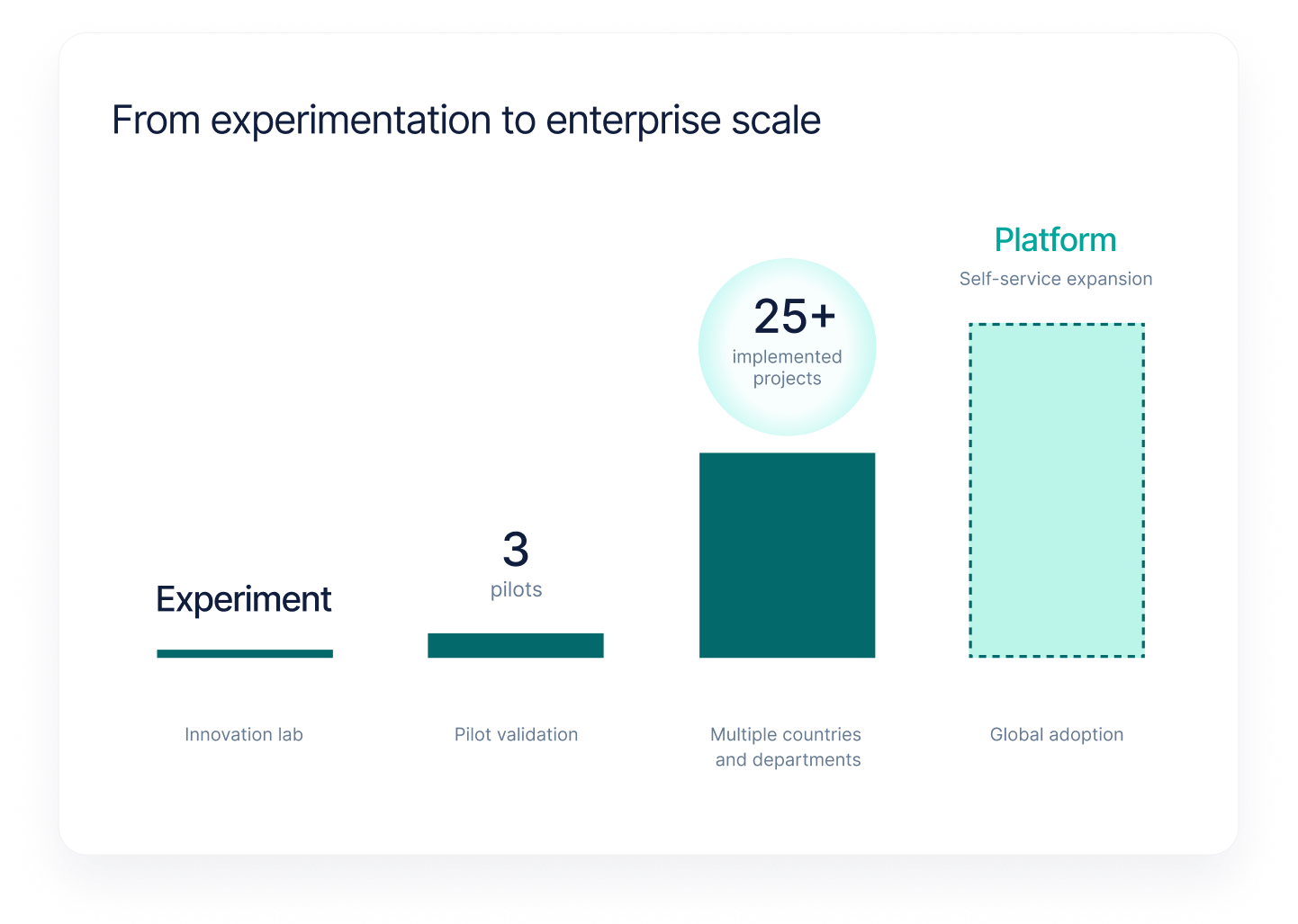
Critical capabilities for AI-generated synthetic test data
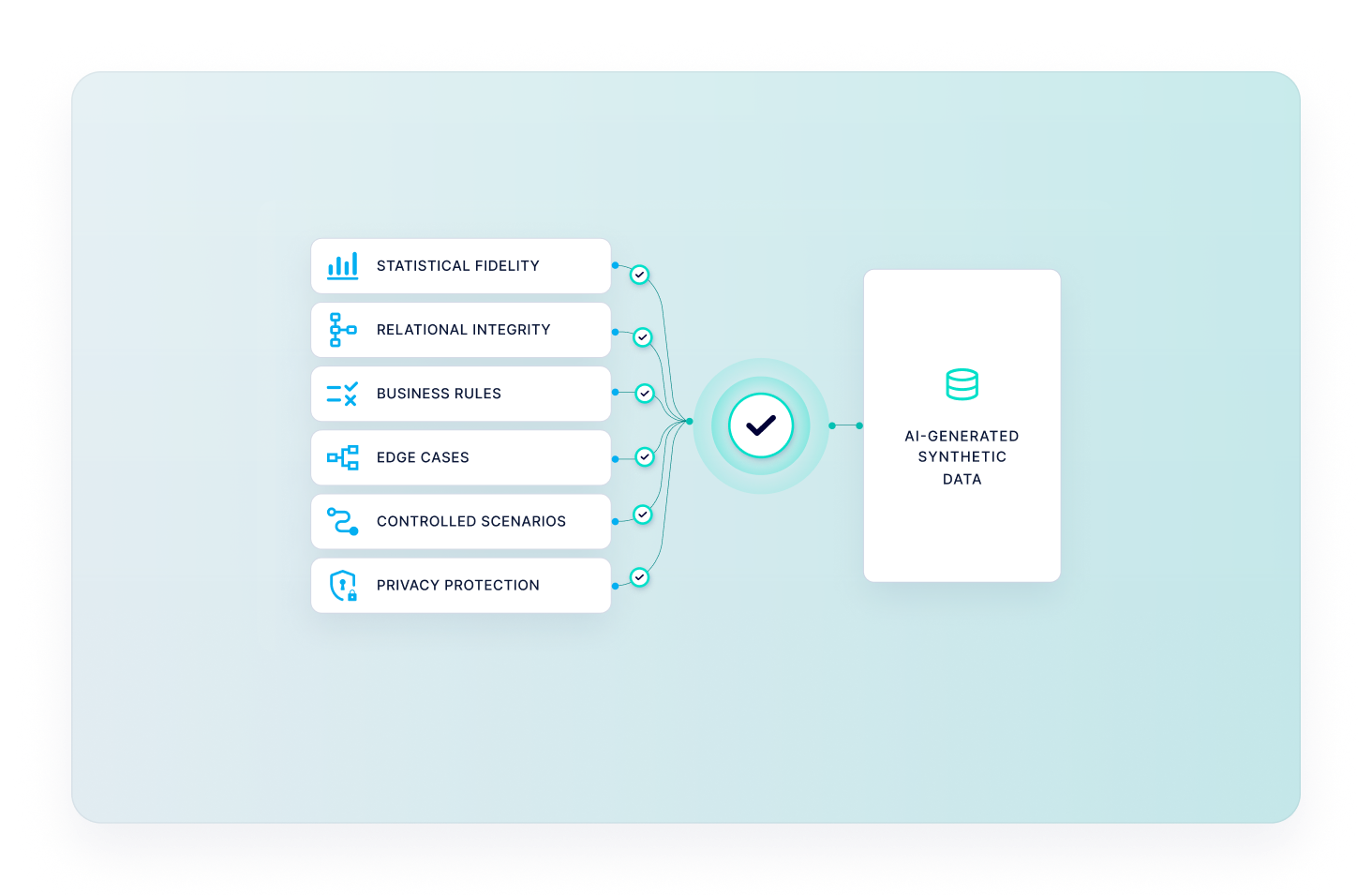
Matching distributions is not enough for software testing. Generated data must preserve relationships, satisfy application rules, and include the conditions and scenarios required to exercise the system.
- 1
Statistical fidelity
Models must generate data that preserves the patterns, correlations and distributions present within individual tables.
- 2
Relational fidelity and integrity preservation
Models must generate data that preserves correlations, keys, relationships, and cardinalities across dozens to hundreds of tables.
- 3
Business-rule and semantic consistency
Models must generate data consistent with business rules, conditional relationships, and hidden context, including rules that span multiple tables.
- 4
Edge-case and out-of-distribution generation
Models must be able to generate boundary cases, invalid cases, and scenarios outside the range of the data used to train them.
- 5
Controlled scenario generation
Models must be able to generate controlled databases for specified scenarios, distributions, volumes, and anticipated future states.
- 6
Privacy-protected data generation
Models must generate data that does not expose sensitive training data.
Guides and resources
Cookbook
Put synthetic data to the performance test
Compare production, rules-based, and AI-generated synthetic data in a hands-on tutorial, and see how data realism affects a simulated transaction‑processing workflow.
Tech blog
How AI-powered synthetic data boosts software engineering
ING explains how synthetic data can improve test-data availability and support software-engineering workflows.
Tech blog
How to scale adoption of AI-powered synthetic data at enterprise level
ING shares the organizational and technical lessons behind expanding synthetic data from an experiment to enterprise adoption.
Frequently asked questions
SDV Enterprise is delivered as a Python SDK and runs inside infrastructure your organization controls, close to your production data and testing environments.
No production data or trained models leave your environment. DataCebo does not host, store, or access them. SDV Enterprise transmits limited usage and diagnostic information for licensing, support, and product operation. This information does not contain customer data or trained models. You can read more about why models train where your data lives and review the SDV Enterprise Operations License Agreement.
Optional direct database connectors are available for PostgreSQL, Microsoft SQL Server, Oracle, BigQuery, AlloyDB, and Spanner. SDV Enterprise can also work with data supplied through CSV and Excel files.
Because SDV Enterprise is a Python SDK, teams can call it from existing scripts, test frameworks, and CI/CD pipelines. A pipeline can load a trained model, generate the records and volumes required by a test, and populate a test database before the test runs.
When a schema changes, your team can update or re-detect the metadata and train a new version of the model. You control when this happens, such as after a schema migration, a significant change in production data, or as part of a release cycle.
Yes. Trained models can be saved and loaded through your existing versioning or artifact system. Teams can store the model together with its metadata, configuration, and SDV version. SDV Enterprise can also reset its sampling state to reproduce the same dataset from the same model and sampling request.
SDV Enterprise operates within your existing security boundary. Your organization controls database credentials, user access, network policies, model storage, and where synthetic data is written. An optional differential privacy capability is available when formal privacy guarantees are required.
Your team operates SDV Enterprise inside your environment. A platform, data, or test data team can manage installation, model training, and refreshes. Developers and testing teams can generate datasets through approved scripts and pipelines. DataCebo provides the software, updates, documentation, and customer support.
