

The Economy Rankings recently published its “Top 30 Synthetic Data Platforms 2027” list, placing DataCebo’s commercial platform SDV Enterprise at #1. The report evaluates a range of synthetic data platforms, from tools focused on individual datasets to systems designed for enterprise databases.
Original ranking: https://rankings.economy.ac/technology/2026/10/202610289377
In our view, this report signals the maturity of the market. It is the first to identify important requirements for synthetic data platforms in detail, including the ability to address enterprise data complexity, delineate and provide functionality for task-specific data generation, evaluate synthetic data, measure privacy, and—most importantly—integrate into existing workflows. These are useful benchmarks for anyone evaluating synthetic data technology, and ones we have spent years considering. The report also correctly identifies market consolidation and relevant players.
At the top of that list are five Tier 1 platforms, ranked by position:
| Rank | Platform | Company |
|---|---|---|
| 1 | SDV Enterprise | DataCebo |
| 2 | Tonic Fabricate | Tonic.ai |
| 3 | NeMo Data Designer | NVIDIA |
| 4 | SAS Data Maker | SAS |
| 5 | Syntho Engine | Syntho |
Summary of 2027 Ranking
The Economy Rankings organizes its list into tiers. We have prepared a short graphic summarizing the leading platforms. In Tier 1, platforms are ranked from #1 to #5. In Tier 2 and 3, they are in alphabetical order.
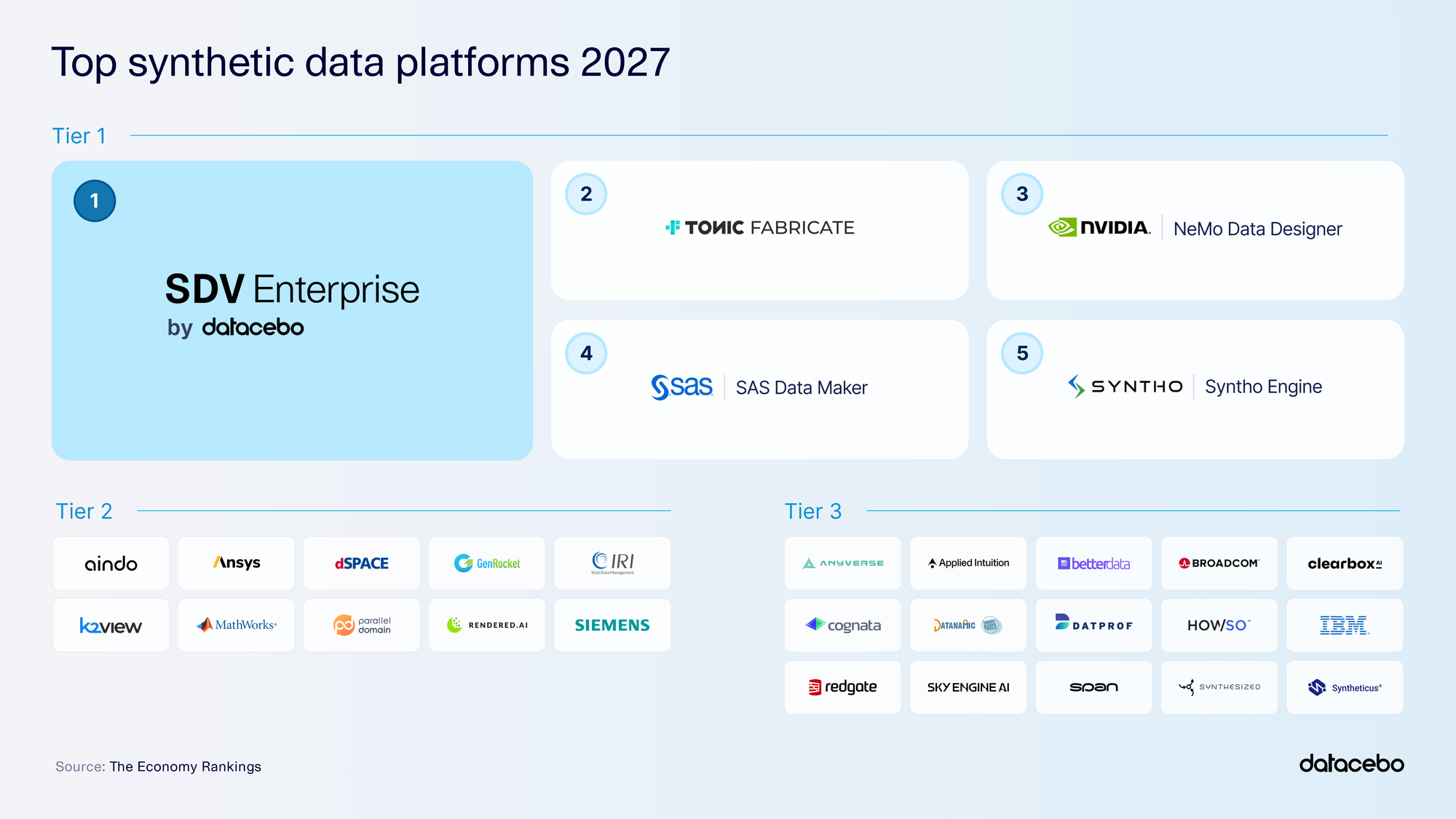
Rankings cannot replace testing a product against your own requirements. If you are evaluating a synthetic data platform, we recommend setting up a relevant evaluation framework based on the type of data you want to generate and your specific use case. For example, if your goal is to generate synthetic data for testing software applications, we recommend using a product that achieves critical capabilities for AI-generated synthetic test data.
What must a synthetic data platform be able to do?
The Economy's review is comprehensive and applies multiple criteria. Below, we highlight a few important ones and connect them to DataCebo’s commercial platform, SDV Enterprise.
A synthetic data platform should:
Generate data that is relationally consistent and captures your business context. Applications consume databases with primary and foreign keys, dependencies, constraints, and business rules. A useful synthetic data platform won't just create a table that looks statistically similar to another table—it will generate a database that preserves these relationships while allowing teams to create new scenarios. DataCebo’s commercial platform SDV Enterprise is built for this problem. Recently, we highlighted the many enterprise complexities addressed by SDV Enterprise in the announcement of our major new release, SDV 2.0. We also shared our list of critical capabilities necessary for one specific use case, namely synthetic data test provisioning for software development.
Measure the quality of generated data. Evaluating synthetic data is just as important as creating it. Evaluation covers many concepts. First, generated data should pass basic checks for referential integrity, basic database structure, and business context. Next, it should also be evaluated for data quality— the statistical fidelity between the original and synthetic data—based on column-wise statistics, distributions, correlations, and patterns between tables. Finally, users should measure the actual ROI associated withusing the synthetic data for its intended task. At DataCebo, we developed the SDMetrics library to make all these evaluations a repeatable part of the workflow.
Explicitly consider privacy. Users shouldn't automatically consider synthetic data to be private just because it's AI-generated. Privacy needs to be measured too. SDV Enterprise provides a number of measures aimed at evaluating privacy, including verifying the anonymization of PII attributes (or combinations of data that could be PII), and verifying that the synthetic data isn't overfit to the real data in a way that leaks privacy. SDV Enterprise also offers formal privacy guarantees, including Differential Privacy when generating data, and a Trust-but-Verify framework for checking that privacy preservation actually worked.
Fit how teams actually work. Synthetic data generation platforms should be programmable, documented, and usable in existing development environments. SDV Enterprise is built around this requirement, and includes SDKs and bundles for various workflows. Explore our documentation here.
How we got here: research, open source, and enterprise application layer
Since the beginning, we have taken a systematic approach to commercializing SDV, bringing an MIT research project out of the lab and turning it into an effective enterprise platform.
In 2015, we had the idea to create generative models for relational databases, a project we named the Synthetic Data Vault (SDV). Between 2015 and 2021, we developed multiple approaches for modeling relational data, including with copula and GAN-based models. These six years of research and experimentation focused on ensuring SDV could learn statistical patterns from real datasets.
In March 2021, we began a concentrated effort to transform a research project into an accessible, useful open-source ecosystem, which we called SDV Community. Over the next three years, we invested in documentation, APIs, usability, tutorials, and user support. In 2023, we hit 1 million downloads, and in 2025, we hit 10 million for the entire ecosystem. Making SDV publicly available and open-core allowed us to turn a research software into a battle-tested, usable platform. SDV Community also educated many enterprises about what this technology can do, and became the core underlying our commercial platform.
We launched DataCebo’s commercial platform, SDV Enterprise, in 2024. We had already solved the challenge of building generative models; now, we needed to make those models work for specific enterprise applications. Working with enterprise design partners, we identified missing capabilities and built application layers. Software testing is one example: with SDV Enterprise's software testing application, teams can repeatedly generate synthetic databases, configure them for specific test scenarios, and use them within their existing testing workflows.
At DataCebo, we continue to research the possibilities of synthetic data generation, maintain and support users of SDV Community, and bring enterprise and application-centric functionality into SDV Enterprise. If you are looking to learn about synthetic data and what it can do, we recommend trying out SDV Community. If you would like to pursue a POC for a use case, we recommend starting with SDV Enterprise.
Disclosure: DataCebo has no financial relationship with Economy Rankings and did not pay for inclusion or placement in this ranking.
Source: https://rankings.economy.ac/technology/2026/10/202610289377